

There are moments when the right words simply do not come. Someone you care about has lost a person or a pet they loved, and every sentence you draft in your head sounds either too big or too small. You may even put off reaching out because you are afraid of getting it wrong.
A gift cannot fix anything, and it should not try to. What it can do is say, quietly and without needing a reply, that someone is thinking of them. This guide is about choosing that kind of gift with care: what to look for, what to write in the card, which details deserve a second look and how to let the gesture be gentle.
Why a quiet gesture usually works best
People in grief are often tired. Phones fill up with messages, the house fills up with flowers and casseroles, and every kind gesture comes with a small expectation that it will be acknowledged. A remembrance gift that asks nothing of the person is easier to receive than one that demands attention, setup or a big reaction.
That is why calm usually beats clever. Choose something that sits comfortably in a room, in muted colors that do not shout, and leave humor out unless you know the person well enough to be certain it will land. If they would laugh at a joke about the friend who has gone, you will know. If you are guessing, do not guess.
Ask yourself three questions
- Will it be easy to place? A small object that can go on a shelf, a mantel or a tree asks for no rearranging.
- Is it about them or about me? The best remembrance gifts center the person or pet who is missed, not the giver’s wish to help.
- Could it be misread? A cheerful tone can feel dismissive. When in doubt, go plainer and softer.
Gifts that are meant to be kept close
An object made for remembrance works differently from a general gift. It is not a thing to be used up. It is something that stays, perhaps on a windowsill or a bookshelf, and gives the person a place for their feelings to rest when they want one. Our keepsakes are organized with that idea in mind, and a few pieces are especially suited to this moment.
For a person who has died
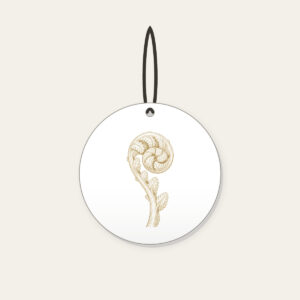
Unrolling Fiddlehead Fern Ornament. One fiddlehead fern uncurls from its tight spiral, drawn in clean cream lines with delicate frond details. There is a lot of empty space around it, so the artwork feels peaceful and deliberate, a small symbol of growth in the stillness of a forest morning.

For a pet who has passed
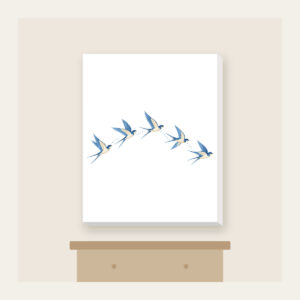
Five Swallows in a Gentle Arc Canvas Print. Five swallows fly in a gentle arc, drawn in cream and sky blue, with a fine dotted trail showing the path they have already crossed. The wings are light and the spacing is open, which gives the motif a hopeful, forward-looking feeling.
If the person you are shopping for has a favorite photo of their pet, they may have ideas about how they would want to remember them. Keep your own gift simple and let them lead on anything more elaborate.
These gift ideas include made-to-order designs. Choosing finished artwork does not mean an item is in stock or ready for immediate delivery. Some selections use finished artwork; only choose custom text where the listing offers it. Check each product’s options and the shipping information before planning when to give it. The photographs illustrate gift-giving ideas; use each product’s listing to see its own design.
Unrolling Fiddlehead Fern Ceramic Ornament
- Free gift
$19.95In stock
Five Swallows in a Gentle Arc Canvas Print
- Free gift
$39.95In stock
What to write in the card
The card often matters more than the object. It is where you say the thing you could not say in person, and it is where most people freeze. Short and honest is best. You do not need to explain loss, offer a reason or give advice that sounds like a lesson. A few plain lines do a great deal.
- “I was thinking of you and of [name] today.”
- “There is no need to reply. I just wanted you to know I am here.”
- “I remember when [a specific, kind memory].”
The third one is often the most valued, because many people worry that others will stop mentioning the person who died. A small, true memory tells them they are not alone in carrying it. If you want more help finding words, our guide to writing a note to go with a gift covers tone and length in more detail.
Phrases to leave out
Some well-meant sentences land badly. “They are in a better place,” “At least they are not suffering” and “Everything happens for a reason” can feel like an attempt to close the subject. You do not need to make sense of the loss for anyone. Saying you are sorry, and that you are here, is enough.
Names, dates and the details to double-check
Personalization is the part of a remembrance gift where small mistakes hurt the most. A misspelled name on an object meant to honor someone is hard to look at, so give this step more attention than you would for a birthday gift.

- Confirm the spelling. Ask a relative or close friend, not the grieving person themselves, if you can. Check nicknames too: some people want the name everyone used, not the one on the paperwork.
- Think before adding a date. Some people find a date comforting. Others would rather not see it on display every day. When you cannot be sure, choose the name alone.
- Use the preview. Look at how the design will appear before you order. Our page on previewing before you order explains what to look for.
- Keep wording short. A name is often enough. Extra lines can feel crowded on a small piece, and shorter text is easier to get right. Choosing between text, dates or initials is worth a read if you are undecided.
Timing can be gentle too
There is no deadline for kindness. Many people feel held in the first days after a loss and then quietly forgotten once the casseroles stop coming. A thoughtful gift that reaches them a month or two later can land with real weight, because it shows you are still holding the memory after everyone else has moved on.

That also takes pressure off you. If you missed the first days, you have not missed your chance. Birthdays, anniversaries of the loss and the first holiday season without the person are all natural moments to reach out again, as long as you keep the tone soft.
When delivery matters, for example if you hope to send something to someone in another city, check the shipping page for how it works and leave yourself plenty of time. Delivery depends on where you live and on the carrier, so it is better to plan a little ahead than to rush.
Give it, then let it be
The hardest part of a remembrance gift may be the part after you send it. Do not wait for thanks, and do not read silence as a sign that you chose wrong. Some people will message you the same day. Others will need weeks, or will never find the words, and that is fine. They may simply keep the object and say nothing.
It can help to remember that grief does not follow a schedule. A person may seem fine at the service and come apart in the grocery aisle a month later, or the other way around. You are not responsible for choosing the perfect moment. You are only responsible for being kind at some point, and then again after that.
If you see them again, you do not need to ask whether they liked it. A kind hello, or a mention of the person who is missed, does more than any follow-up question. And if you find yourself wanting to send something more, a note on an ordinary Wednesday can mean as much as a gift.
If you are looking for something else for a friend who has a lot on their mind and little appetite for gifts, the idea in a gift for someone who wants nothing may also help. You can find more reflections in our journal.
FAQ
Is it appropriate to send a gift after a loss?
Yes, as long as it is quiet and comes with a short, kind note. Choose something calm and small, and avoid anything that asks for an immediate response.
What if I do not know the person well?
A card on its own, with one honest line, may be the most fitting gesture. If you do add a gift, keep it simple, and check names and details with someone who knows the family.
Should I include a date on the gift?
Only if you are confident the person would want it displayed. Some people find dates comforting and others prefer to leave them out, so the name alone is the safer choice.
How late is too late to send something?
It is never too late. A gift that reaches someone a month or two after the loss, or around a birthday or anniversary, often means more than one sent in the first rush of messages.