
Names are personal, and they travel the world in many forms. A single name can be written in different alphabets, shortened in different ways and ordered differently depending on where a family lives. When you personalize a gift for someone whose language or culture differs from yours, a little extra attention goes a long way.
This guide covers a handful of habits that help. It does not assume anything about any particular tradition, because the point is the opposite: the person receiving the gift is the best authority on their own name, and your job is to find out what they would choose.
Start by asking how the name is written
The simplest rule is to ask. Ask the person, or someone close to them, how they like their name to appear. That covers the order of the parts, the spelling and the capitalization. In some cultures a family name comes first, in others it comes last, and some people go by a single name only. There is no universal pattern, so a gift built on an assumption can go wrong in a way that is hard to see from the outside.
The way a person introduces themselves is the best guide. Look at an email signature, a message they wrote or the way a relative addresses them. If you are shopping for a surprise, a casual question such as “How do you like your name written on a card?” works nicely and gives nothing away.
Name order and family names
For gifts that carry a family name, check whether everyone shares one. Spouses, parents and children sometimes use different surnames, and a design that assumes a single family name may not suit them. If a design lists several names, it is often the better choice to write each person’s name as they use it rather than forcing a shared label.
Accents and special characters
Names often include accents, hyphens and other marks. Whether a product can reproduce a particular character depends on the item and its personalization options, so read the product page and the preview carefully. As an example, letters such as é, ñ and ł print just fine on our two-person mug, while emoji and some scripts cannot be printed yet, and the field says so before you add anything to your bag.
If a character cannot be shown, resist the urge to guess. Ask the person which simplified form they would prefer. Some people are happy with a plain-letter spelling, and others would rather you chose a different design. Either answer is useful, and both are better than a surprise.

Family pieces and shared names
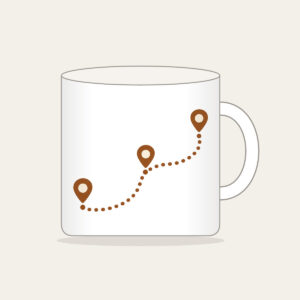
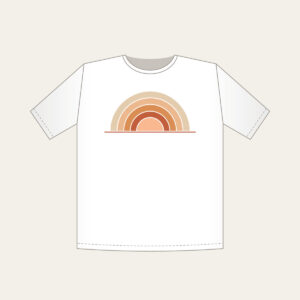
Dotted Route Linking Map Pins Mug. A dotted route line wanders across a warm brown ground, linking small cream map pins one by one. Each pin marks a stop and each dot a step, so the pattern reads like a travel diary reduced to its simplest lines. Stepped Arc Sunrise Over the Horizon T-Shirt. Five stepped arcs rise above a single thin horizon line, graded from apricot to rust and sand, to form a sun that is just beginning its day. The composition is minimal and balanced, a quiet picture of beginnings.
Before you order, find out which version everyone prefers. If the family is split, you can sometimes choose a design where each person’s own name appears, so no one’s spelling is chosen over anyone else’s. For a reunion, the person organizing the event usually knows how the family writes the name, and a quick message to them is faster than a long guess.
These gift ideas include made-to-order designs. Choosing finished artwork does not mean an item is in stock or ready for immediate delivery. Some selections use finished artwork; only choose custom text where the listing offers it. Check each product’s options and the shipping information before planning when to give it. The photographs illustrate gift-giving ideas; use each product’s listing to see its own design.
Dotted Route Linking Map Pins Mug
- Free gift
$21.95In stock
Stepped Arc Sunrise Over the Horizon T-Shirt
- Free gift
$24.95In stock
Copy, do not retype
The most reliable habit is to copy and paste the name from a message the person wrote, and not to retype it from memory. Retyping invites small changes: a dropped accent, a changed vowel, a smoothed-over hyphen. Pasting preserves exactly what the person chose.
Then compare the preview with the original, character by character. The preview shows how the design will look before you order, so it is the right moment to catch a difference. If you cannot read the language, ask a friend or a relative who can to look at the text for you. A second reader catches things that your eyes skip.
A few habits that help
- Ask first. A short message before ordering avoids most mistakes.
- Copy, do not retype. Paste the name from something the person wrote.
- Check the preview. Look at every character, not just the general look.
- Keep a plan B. A simpler spelling the person has approved is a good fallback.
- Keep it short. Fewer words mean less to get wrong. Our post on names that fit explains why.
If the name will appear in more than one language, our guide to writing names in more than one language goes into scripts, bilingual layouts and proofreading in more depth.
Nicknames, titles and terms of address
Many languages have rich ways to address family members, and those words often carry more warmth than a given name. A grandmother may be Oma, Abuela, Nonna, Lola or Bà in different homes, and children in the same family may use two of them. If a design includes a title, ask the family which word they use and how it is spelled in their own writing.
The same applies to honorifics. Some people like a title next to their name, and others would find it stiff. A simple test is to look at how the person signs a greeting card. If they sign with only a first name, a gift with only a first name will feel right. If they always include a title, the gift can too. When in doubt, the shorter and more familiar choice is the safer one.

Respect the occasion as well as the name
Holidays, symbols and colors carry different meanings in different places. A design that feels cheerful in one family can feel out of place in another, and a holiday that matters deeply to you may not be one the recipient celebrates at all. If you are not sure whether a design suits the person’s traditions, choose a neutral one or ask a family member.
A kind question is always better than a confident guess. It also shows that you care enough to ask, which is part of what a personalized gift is meant to say. If you are planning a gift across time zones or national borders, our posts on gifting someone in another country and holiday gifting across time zones cover the planning side.

When the recipient lives far away
Gifts for people in other countries often start with a conversation across time zones, and that conversation is a good chance to ask the name questions. A short message, a quick call or a note from a mutual friend can settle spelling, order and preferred form in one go. Save the reply, because you can paste from it when you fill in the form.
If the person is a relative you have not seen in years, ask someone in the family instead of guessing from old documents. Spellings change when families move, and the version on an old letter may not be the one the person uses today. A gift that gets the name right shows that you kept up with them, even from far away.
Planning for delivery and timing
When a gift travels, remember that delivery depends on where the person lives and on the carrier. Leave plenty of time, especially when the gift is meant for a specific day, and read the shipping page for how it works. If something about the order needs to be changed, the help page is the right place to begin.
A worked example
Imagine you are ordering a mug for a friend who grew up in one country and now lives in another. You know her as Mei, but her messages are signed with a longer name. You ask her, in a friendly way, how she likes her name written on a card, and she sends the long form with its spacing. You paste it into the form, check the preview against her message, and ask a mutual friend who reads the language to confirm that nothing changed.
Three small steps, each of them a minute or two. The result is a gift that treats her name as hers, and not as your best approximation of it.
Everyone is welcome
Gnesty is written and shown in English, but gifts travel to many places and belong to people of many backgrounds. If a detail is unclear, the how to personalize page and the help page are good places to start, and the shop is open for browsing whenever you are ready to compare designs.
FAQ
What is the best way to find out how someone writes their name?
Ask them or someone close to them, or look at something they wrote themselves, such as a message or email signature.
What if a product cannot show a character in the name?
Ask the person which simpler spelling they would like, or choose a different design. Check the product page and the preview before you order.
How do I handle a family whose members spell the surname differently?
Ask which version everyone prefers, or pick a design where each person’s name appears the way they write it.
Should I translate a name?
No, unless the person asks you to. Write the name as they write it.