
Most pet gifts go wrong in the same way: too many words. The giver loves the dog, has a dozen things to say about the dog, and tries to say all of them on one mug. The result is a crowded design where nothing is easy to read and the best joke is lost among the second-best.
This is an editing guide. It treats the words on a personalized pet gift the way a good editor treats a headline: decide what matters, cut the rest and check that what is left sounds like the person and the animal it is for.
The one-line rule
Before you type anything into a product page, write down the single thing the gift should say. Not the three things. One. It might be the dog’s name, the fact that the owner is a dog mom, or an inside joke about stealing socks. Everything else is decoration.
That sentence becomes your test. If a word does not support it, it does not need to be on the gift. This is harder than it sounds, because every detail feels important when you love the animal. The trick is to remember that the owner already knows every detail. The gift only has to hold the one that makes them smile.
A quick test you can run
Imagine the gift on a table across the room. Can you tell, at a glance, whose it is and what it says? If the answer is “I would have to pick it up,” there are too many words. Shorten until the main line works at a distance.
Names: how many, in what order
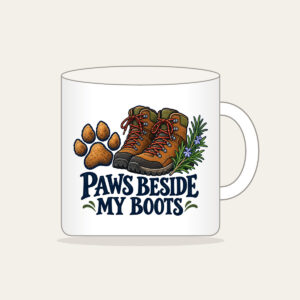
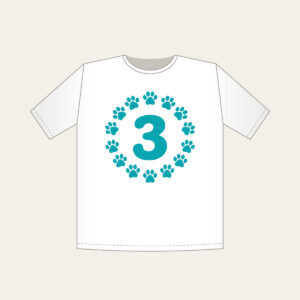
Paws Beside My Boots Mug. PAWS BESIDE MY BOOTS Mug features line-art artwork showing one dog pawprint beside two hiking boots and a rosemary sprig, thick navy contours. The lettering reads “PAWS BESIDE MY BOOTS”. Teal Paw Circle with Number Three T-Shirt. Tiny white paw marks march in a neat circle across a deep teal ground, all of them gathered around a bold “3” in the center. The graphic is crisp and cheerful, equal parts team badge and pet-parent pride.
- Lead with the pet the owner would say first. Households have an order. Follow it.
- Use the name the owner uses. Registered names are often long and formal; use the one that gets shouted across the park.
- Check capitalization and punctuation. A hyphen, an apostrophe or an unusual letter should be copied exactly, not guessed.
- Do not add every pet. If the household has four animals and the product has room for two, choose the ones who are central to the joke or the memory, not the full roll call.
Nicknames and titles
A nickname gives a gift personality, but it also invites clutter if you stack it on top of a full name. Choose one or the other, unless the product layout clearly has space for both.
Before and after
Here are a few typical drafts and what they look like after editing:
Draft: Winston Archibald Barkley the Third, our loving, goofy, always-hungry Frenchie. Edit: Winston.
Draft: Best Dog Mom Ever to Luna, Milo and Daisy since 2019. Edit: Luna, Milo and Daisy.
Draft: Chief Executive Officer of the Sofa, Head of Security and Official Sock Thief. Edit: Chief Sock Thief.
Notice what happened in each case. The long version tried to describe the pet; the short version simply identified them. A short title works only if it is specific. “Chief Sock Thief” lands because it points to one habit. “Best Dog Ever” could be about any dog and is easily forgotten.
Where jokes and sentiment belong
Humor and warmth are good on a gift, but they work best in measured amounts. A few guidelines:
- One joke, not three. If the dog steals socks, hogs the sofa and barks at the vacuum, choose the one the owner tells most often.
- Keep sentiment short. “Our good boy” is warm and quick. A paragraph about unconditional love belongs in a card, not on a mug.
- Match the tone to the product. A hoodie can carry something understated. A mug is a good home for a gentle joke. A keepsake ornament suits a name and a year.
- Avoid in-jokes that need a footnote. If the recipient would have to ask what it means, it belongs in a note rather than on the item.
Years, dates and other extras
A year is one of the best additions you can make because it turns a funny item into a keepsake. But a year only helps if it means something to the owner. A gotcha day, a birth year or the year a puppy came home all work. A random year does not.
If a product lets you add a date, decide whether it earns its place. Ask: would the owner care about this date in ten years? If yes, add it. If not, leave it out.
Not every item supports every extra. The options differ from product to product, so read the product page, not just the photos, and our personalization questions page can answer the common doubts.
Three drafting exercises that help
If you are stuck, these quick exercises usually shake loose a better line than staring at the order form.
- The text-message test. Imagine texting a friend the shortest possible description of the pet. Whatever you would actually type is usually closer to the right wording than a polished phrase.
- The three-word cut. Write the line you want, then rewrite it in three words or fewer. Often the shorter version is simply better, and when it is not, you have learned which word was carrying the meaning.
- The overheard line. Think of something the owner says to the pet every single day: a pet name, a command, a tease. Those lines tend to be affectionate, specific and unforced.
Once you have a candidate, put it away for an hour and come back. Words that looked perfect while you were excited often need one more cut when you read them fresh. That small pause is the cheapest quality check there is, and it is worth doing even when you are in a hurry.
Checking before you order
Typos on a personalized item are permanent, so slow down at the final step.
- Read the text aloud, slowly, as if introducing the pet.
- Compare each name to a reliable source, such as a message from the owner or the vet record.
- Look for duplicated words, stray spaces and the wrong capital letters.
- Ask someone else to read it cold. A fresh pair of eyes catches what you have stopped seeing.
- Check the preview, if one is shown, and confirm that nothing looks squeezed.
For anything about returns or changes after ordering, read the returns page instead of assuming. It is better to get the words right the first time than to rely on fixing them later.
Matching words to the type of gift
For a mug
Mugs reward short text. They are lifted, turned and glanced at. A name and a tiny phrase read well; a paragraph does not. If you are choosing between several styles, browse the mugs collection and see what each one is designed to carry.
For a tee or hoodie
Wearable gifts are seen from a distance, so brevity matters even more. The owner is going to wear this to the park, and a name that reads across a pavement is better than a long phrase nobody can follow. Compare options in the t-shirts collection and check the product page to see what each design allows.
For a keepsake
Ornaments and similar pieces work best with a name and a year. They are small, and the simplicity is part of their charm. If you are exploring ideas for the dog-person on your list more broadly, our pet portrait gift ideas and dog dad and cat dad gift ideas pair well with this guide.
These gift ideas include made-to-order designs. Choosing finished artwork does not mean an item is in stock or ready for immediate delivery. Some selections use finished artwork; only choose custom text where the listing offers it. Check each product’s options and the shipping information before planning when to give it. The photographs illustrate gift-giving ideas; use each product’s listing to see its own design.
Paws Beside My Boots Mug
- Free gift
$21.95In stock
Teal Paw Circle with Number Three T-Shirt
- Free gift
$24.95In stock
FAQ
What if I want to include both a name and a joke?
You can, if the product page shows room for both. Keep the joke shorter than the name and place the more important element first.
Is it better to use a nickname or the full name?
Use whichever the owner actually says. A formal name that nobody uses can feel stiff, while a nickname everyone uses feels immediately right.
Can I add several pet names to one gift?
Some products support more than one name and others do not. The options listed on each product page are the final word, so check before you plan your wording.
How do I check my wording one last time?
Read it aloud, compare spellings to a reliable source and ask a second person to proofread. Our personalization guide shows the ordering steps in sequence.