

Every long friendship has a private language. A phrase from a road trip nobody else was on, a nickname that began as a typo, a rule about who gets the last fry. Inside jokes are hard to explain and easy to love, which is exactly why they make such good gift material.
The trick is moving a joke that lives in two heads onto an object that lives on a desk, in a kitchen or in a closet. Done well, your friend laughs the second the wrapping comes off. Done badly, it reads like a puzzle with no answer key. This guide covers how to choose the right joke, how to word it, and which kind of gift suits which kind of friendship.
Why a shared joke beats a generic slogan
Gift shops are full of best-friend lines about soulmates and partners in crime. They are perfectly nice, and some friends will love them. But a line that could belong to anyone belongs to no one in particular. A reference only the two of you understand does the opposite: it proves you were paying attention at the moments that mattered.
There is a practical upside too. A joke-based gift feels personal even when the wording is short, so you can keep the design simple and let the joke do the heavy lifting. You do not need a paragraph. You often need three words and the confidence to use them.
Mining the joke: five questions to ask yourself
If nothing obvious jumps out, work through these prompts. Write down every answer, even the weak ones, and then circle whichever makes you smile first.
- What phrase do we repeat without noticing? The sentence one of you says and the other finishes is usually the winner.
- Is there a nickname with an origin story? A name that started as a mistake and stuck is pure gift material.
- What disaster do we laugh about now? A missed train, a burnt dinner, a wrong turn that became the best night of the trip.
- Do we have a ritual? A standing Sunday call, a shared order at the same cafe, a rule for movie nights.
- What do other friends tease us about? If the whole group knows the joke, a gift built on it will land with everyone who sees it.
The three-second test
Before you commit to wording, picture a stranger glancing at the gift for three seconds. Which of these happens?
- It reads clean. The words are funny or warm even without context. These work almost anywhere.
- It reads cryptic. Only the two of you get it. That is lovely on a mug that stays at home, and less ideal on something worn to a crowded place.
- It reads awkward. A stranger might misread it or feel uncomfortable. Rework it, because the joke that feels harmless between you may not feel that way on an object other people see.
Where the gift will live matters as much as the joke. A mug stays in a kitchen and sees only invited guests. A shirt goes out into the world. Choose the object that matches how public the joke should be.

Matching the joke to the object
For the joke you share over coffee
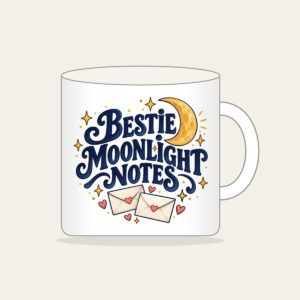
Bestie Moonlight Notes Mug. BESTIE MOONLIGHT NOTES Mug features typography artwork showing bold indigo lettering with a gold crescent moon, two blank envelopes and tiny coral hearts. The lettering reads “BESTIE MOONLIGHT NOTES”. For related guidance, see mugs collection.
For the joke with a reveal
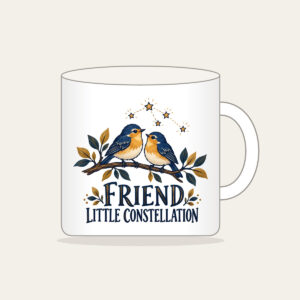
Friend Little Constellation Mug is another design to consider for this gift idea.
For the joke you want to wear together
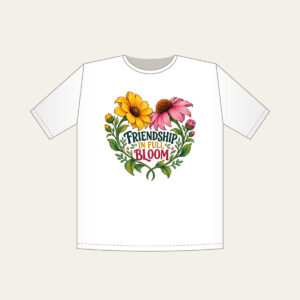
Friendship in Full Bloom T-Shirt. FRIENDSHIP IN FULL BLOOM T-Shirt features botanical artwork showing two different flowers leaning toward each other with stems forming a loose heart. The lettering reads “FRIENDSHIP IN FULL BLOOM”.

Wording a joke so it survives being printed
Spoken jokes lean on timing, tone and a raised eyebrow. A printed line has none of that, so it needs a little help.
- Keep it short. If you need more than a line, the joke may be too complicated for the object.
- Use the exact phrase, spelled the way you both say it. A garbled quotation loses half the effect, and a “corrected” typo may be the whole joke.
- Skip the explanation. The moment you add context, you have turned a joke into a caption.
- One joke per gift. Two references make each one weaker.
- Check capital letters and punctuation. A missing question mark can change the tone entirely.
If you are not sure which fields a product accepts, our personalization guide walks through the process, and the personalization questions page covers the small details worth checking before you order.
Jokes to leave off the gift
A joke that works across a table can sour once it is permanent. Skip anything that:
- mocks your friend’s appearance, health, age or finances, even affectionately;
- involves an ex, a family conflict or a third person who did not choose to be in it;
- depends on a very recent hurt that your friend may not be ready to laugh about;
- you would hesitate to hear read aloud at a birthday dinner.
When in doubt, ask yourself whether your friend would be happy to explain the line to their own grandmother. If the answer is yes, you are probably fine.
One more habit that helps: test the wording on paper before it goes anywhere near an order form. Write it by hand, then type it, then say it out loud. Handwriting shows you whether it is too long, typing shows you how it looks in a tidy font, and speaking shows you whether the rhythm still sounds like the two of you. If any of those three versions feels flat, the joke probably needs a shorter or sharper phrasing.

Gifts for different kinds of friendship
Friendships come in different shapes, and the same joke can need a different object depending on the shape. Here are four common situations and how we would approach each.
The friend who is moving away
A joke on a mug is a small piece of home they can unpack first. If your friend is relocating, you may also like our ideas for moving-away gifts.
The friend group
If the joke belongs to three or more people, check whether the product you like can carry more than one name or set of initials. If it cannot, give each person their own matching piece rather than squeezing too much onto one.
The newer friend
With someone you are still getting to know, go for a light, low-stakes reference such as a coffee order or a shared complaint about Mondays. Save the deep cut for when it has had time to ripen.
The friend who hates sentimental gifts
Humor is your best route in. A joke gift lets you say “I care about you” without anyone having to hold eye contact. For more on getting the tone right, see our guide to funny personalized gifts that land well.
These gift ideas include made-to-order designs. Choosing finished artwork does not mean an item is in stock or ready for immediate delivery. Some selections use finished artwork; only choose custom text where the listing offers it. Check each product’s options and the shipping information before planning when to give it. The photographs illustrate gift-giving ideas; use each product’s listing to see its own design.
Bestie Moonlight Notes Mug
- Free gift
$21.95In stock
Friendship in Full Bloom T-Shirt
- Free gift
$24.95In stock
Friend Little Constellation Mug
- Free gift
$21.95In stock
A simple plan for one evening
- Write down five shared jokes, phrases or rituals.
- Run each through the three-second test and cross out the awkward ones.
- Choose the object based on where the joke should live: kitchen, closet or both.
- Draft the wording in your notes app and read it aloud once.
- Check the product page options and confirm spelling with a mutual friend if you are unsure.
If you are still deciding what kind of personalization suits the person, our piece on how to choose a personalization theme can help you narrow it down, and the gift guide has more starting points.
FAQ
What if only I remember the joke?
Then it is not an inside joke yet, it is a memory. Pick one you are sure your friend repeats or reacts to, so the gift feels like a shared moment and not a quiz.
Can a joke gift still be heartfelt?
Absolutely. Humor and affection often arrive together. A joke that only the two of you understand tells your friend that you remember the small things, which is the heart of most good gifts.
Should I explain the joke in a card?
A short note is fine, but resist the urge to decode it. A line such as “you know exactly why” does more than a paragraph of context.
How do I know which personalization options are available?
The product page lists what can be added or changed for each item. Read those options first, then plan your wording around them.