Most disappointments with personalized gifts have nothing to do with the object. They come from a name that was misspelled, a nickname that nobody but one aunt uses, or a design that tried to squeeze too many words into a small space. The good news is that nearly all of it is preventable, and the prevention takes about ten minutes at the order stage.
This article is a practical walkthrough. It covers how to confirm spelling, how to choose between formal and familiar names, how to think about order and count, and how to use the preview as a proofreading step. Keep it open in a tab while you fill in the form.
Spell it out, then spell it again
Before you type anything into the form, write each name on paper and read it aloud. It sounds fussy, and it works. Typing is fast and automatic, so a swapped letter slides past. Handwriting is slow enough that your brain notices when something looks wrong.
If you are not completely sure about a spelling, check it against something the person wrote themselves: a card, a message, an email signature, a social profile. Pay particular attention to the places names go wrong most often.
- Double letters. Hannah, Hanna and Hana are three different people.
- Vowel endings. Sara and Sarah, Katie and Katy, Kristen and Kirsten.
- Hyphens and spaces. Mary-Beth is not the same as Mary Beth, and some people feel strongly about it.
- Accents and apostrophes. They are part of the name, not decoration.
A personalized item is made for one person, so a spelling slip is far harder to shrug off than a typo in a text message. A few minutes of checking now is far kinder to everyone than an awkward conversation later.
Decide between formal and familiar
Does the person go by Elizabeth, Liz, Lizzie or Beth? The version you put in the form is the version they will see every day, so it should match how the people around them actually speak. The question is not which name is correct. It is which name is theirs.
A few cases come up again and again:
- A child with a family-only nickname. If only the grandparents use it, a gift that goes to the whole family may be better with the full name, and a gift for the grandparents alone may be better with the nickname.
- Someone who changed their name. Ask them, or ask someone close to them. Do not guess.
- Two people who share a first name. Add an initial or use the version each of them prefers so the design reads clearly.
If you still cannot decide, quietly ask a sibling or close friend of the person which version they would pick. Nobody minds being asked, and it almost always settles the question.
Mind the order and the count
When a design carries more than one name, two things need your attention: how many names fit, and what order they appear in. Both are easy to settle at the beginning and awkward to repair at the end.
Check the limit on the product page
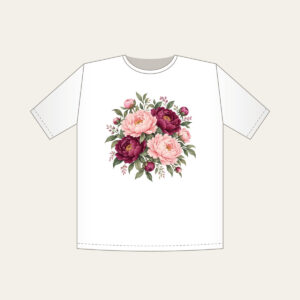
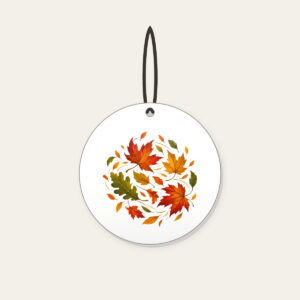
Blush and Plum Peony Blooms T-Shirt. Ruffled peonies in blush and deep plum crowd the space, with sage leaves filling every gap between the blooms. The mood is lush and old-fashioned, like a garden in its fullest week of June. Drifting Autumn Leaves Ornament. Leaves tumble across the artwork in rust, gold and green, each at its own angle, as if a gust had just lifted them from the ground. The movement is gentle and the colors are warm and unhurried, a quiet reminder of crunchy paths, early sunsets and long, slow walks through the woods.
Agree on the order
Order is a quiet source of family politics. Oldest to youngest is the usual default, and it is hard to argue with. Some families prefer to list the adults first and then the children, and some include pets at the end. Whichever order you choose, choose it on purpose, and mention it if the gift goes to someone who might notice.
These gift ideas include made-to-order designs. Choosing finished artwork does not mean an item is in stock or ready for immediate delivery. Some selections use finished artwork; only choose custom text where the listing offers it. Check each product’s options and the shipping information before planning when to give it. The photographs illustrate gift-giving ideas; use each product’s listing to see its own design.
Blush and Plum Peony Blooms T-Shirt
- Free gift
$24.95In stock
Drifting Autumn Leaves Ceramic Ornament
- Free gift
$19.95In stock
Keep the text short enough to read
Every object has a print area, and a long phrase has to be set smaller to fit inside it. Small text can be hard to read on a mug, an ornament or the sleeve of a shirt, especially at arm’s length or across a room. As a rule of thumb, shorter is stronger.
If you have to choose between names and a slogan, keep the names. A name says “this is for you” on its own. A slogan only adds something when there is room for it to breathe. Our post on names that fit shows what that looks like on a mug, and the same logic applies to any other item.
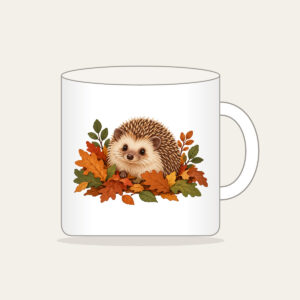
Hedgehog Among Fallen Leaves Mug. A little hedgehog trundles through a carpet of fallen leaves in brown, rust and mossy green, its spines drawn with tiny confident strokes. The scene is quiet and earthy, with the woodsy charm of a storybook autumn afternoon.
Use the preview as a final proofreading pass
If a product offers a preview, treat it as a proofreading step and not as a quick glance. The preview shows how the design will look before you order, so it is the last moment when a fix is simple.
- Read each name letter by letter, ignoring the layout for the first pass.
- Read the whole design aloud, in order.
- Look at spacing and balance on the second pass.
- Ask someone who has not been staring at the form for ten minutes to look.
That last point is the most useful and the most often skipped. A second pair of eyes catches the thing yours have stopped seeing. Our guide to previewing before you order explains why the habit pays off.
Names for gifts that someone else will open
A surprise gift adds a wrinkle: you cannot simply ask the person. You still have options. Ask a spouse, a sibling or a close friend, and ask them to look at the exact text rather than describe it. “Is this how she writes her name?” is a better question than “How do you spell her name?” because people often answer from memory and make the same slip you would.
If the gift is for a child, ask a parent, and ask which version the child uses at school as well as at home. Children often have a playful name for themselves that is not the one on the class list. For a baby or a very small child, a parent’s opinion on the formal name versus a nickname is worth having before you type either one.
A quick checklist to keep nearby
- Write every name on paper and read it aloud.
- Confirm spelling with something the person wrote.
- Choose the version of the name they use every day.
- Check how many names the product supports.
- Decide the order on purpose.
- Look at the preview and read it again, slowly.
A worked example
Say you are ordering a family gift for your sister’s household: two adults, two kids and a dog. Start by writing the five names on paper, in the order you would say them at the dinner table. Then ask your sister to text you the spelling of each one, and paste from her reply. The younger child goes by a short form at home, so you ask which one she would like to see, and she says the long one, because that is what the teacher uses.
Now count. The design you picked has room for six names, so the dog fits. You read the preview aloud, your partner reads it again, and you notice the dog’s name has one letter fewer than you typed. Two minutes later it is fixed. That is the whole method, and it works because each step catches a different kind of slip.
When something looks wrong
If you spot a mistake in the preview, go back and correct it before you order. If you notice something after you have ordered, contact us through the help page as soon as you can. The sooner it is raised, the more options there are.
For a step-by-step view of the form itself, the page on how to personalize covers the common questions, and you can keep browsing in the shop when you are ready to compare designs.
FAQ
Should I use a nickname or a full name?
Use whichever the person uses in daily life. If a nickname is private or only used by one relative, a full or first name is safer for a gift that others will see.
How do I know how many names a design can hold?
Check the product page. Some designs list a limit, for example up to six names on a family tee or up to seven members on a family ornament.
Is it a problem if a name has an accent or a hyphen?
Not at all. Include them exactly as the person writes the name, and check the preview to see how they appear on that product.
What should I do if I am not sure about a spelling?
Ask the person, or someone close to them, and copy the spelling from something they wrote. A short message before you order is better than a guess.